
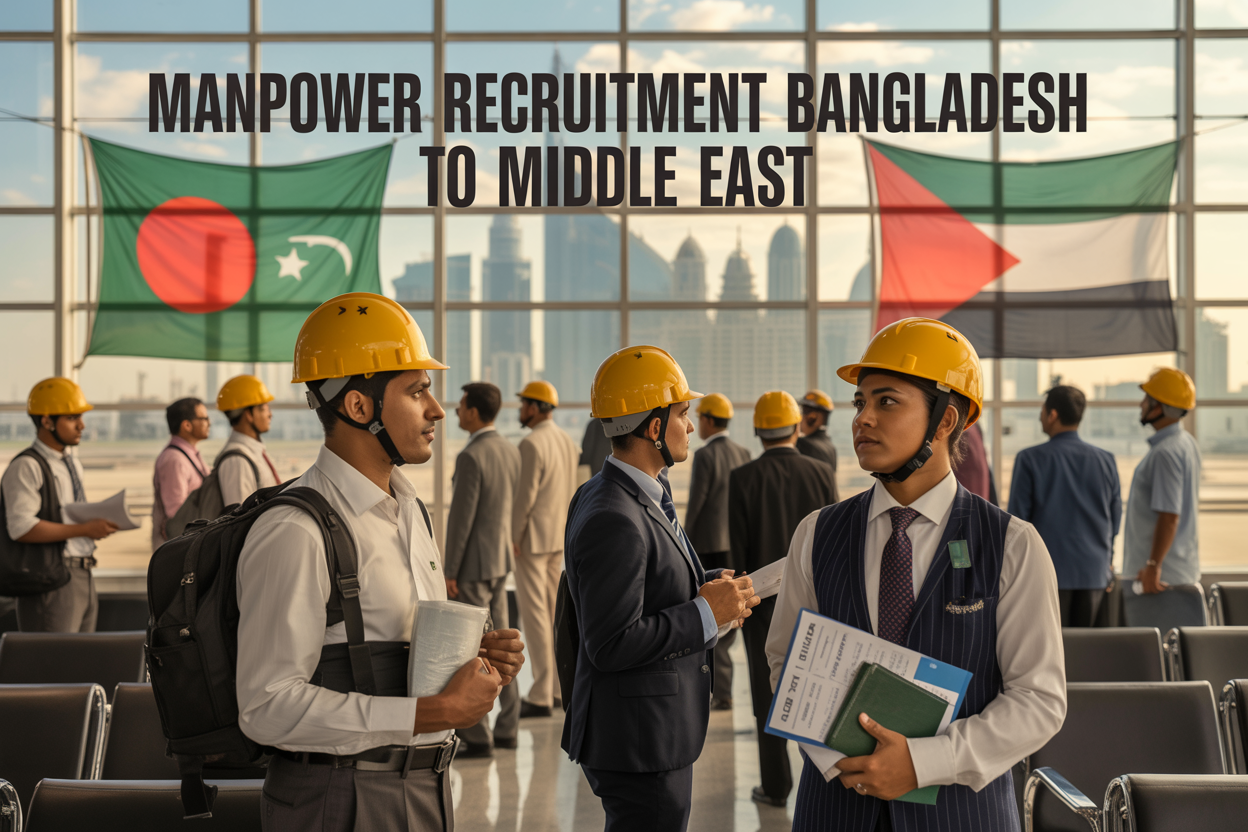
Manpower Recruitment from Bangladesh to Middle East: Your Complete Guide to Overseas Employment
Millions of Bangladeshi workers have built successful careers across Gulf countries, sending home billions in remittances that power our economy. This comprehensive guide helps aspiring migrants, recruitment agencies, and employers understand how the Bangladesh to Middle East recruitment system really works.
Who This Guide Serves
This resource targets Bangladeshi job seekers exploring overseas job opportunities Bangladesh, recruitment agencies managing worker placement, and employers seeking skilled workers Bangladesh export for their Middle East operations.
What You’ll Learn
We’ll walk you through the current demand for Bangladeshi workers across different Gulf countries job recruitment sectors, from construction and healthcare to hospitality and manufacturing. You’ll discover the step-by-step recruitment process, including work visa Middle East requirements and essential documentation.
The guide also covers practical preparation strategies that help workers migrate safely and successfully, plus legal protections every migrant should know about. Whether you’re wondering how workers to abroad at zero cost or need to understand the role of recruitment agencies Bangladesh, we’ve got the real-world insights you need.
From Industry Experience
Drawing from years of experience in overseas employment Bangladesh, including observations from industry leaders like the Managing Director of MULTILINK GROUP, Ershad Ullah, this guide offers practical advice based on what actually happens in the field – not just theory.
Ready to explore Middle East jobs for Bangladeshi workers? Let’s dive into the opportunities waiting across the Gulf region.
Overview of Bangladesh-Middle East Labor Migration

Historical development of workforce migration patterns
Bangladesh’s workforce migration to the Middle East started picking up steam in the 1970s, especially after the oil boom transformed Gulf economies. What began as a trickle of workers seeking better opportunities has grown into one of the world’s largest labor migration corridors. The journey started when Middle Eastern countries needed massive workforces to build their modern infrastructure, from skyscrapers in Dubai to industrial complexes in Saudi Arabia.
Early migrants were mostly unskilled laborers working in construction and domestic services. Over the decades, this pattern shifted dramatically. Today’s Bangladesh to Middle East recruitment includes skilled professionals, technicians, and specialized workers across various sectors. Companies like MULTILINK MANPOWER RECRUITING SERVICE (Recruiting Licence #1282, issued by the Bangladesh Government) have played crucial roles in facilitating this transformation, helping countless Bangladeshi workers access overseas job opportunities Bangladesh that match their skills and aspirations.
The 1980s and 1990s marked significant growth periods, with government backing and formal recruitment agencies establishing systematic pathways for labor migration Bangladesh to Gulf countries. This structured approach replaced informal migration channels, creating safer and more reliable opportunities for workers.
Current scale and economic impact of remittances
The numbers tell an incredible story of economic transformation. Bangladesh currently ranks among the top remittance-receiving countries globally, with Middle East jobs for Bangladeshi workers contributing over $15 billion annually to the national economy. This represents roughly 5-6% of the country’s GDP – a massive contribution that supports millions of families back home.
More than 1.2 million Bangladeshi workers are currently employed across Middle Eastern countries, sending money home regularly to support their families and communities. These remittances have become a lifeline for rural Bangladesh, funding everything from children’s education to small business ventures.
The multiplier effect is remarkable. Every dollar sent home creates additional economic activity in local communities. Families use remittances for:
- Housing improvements and land purchases
- Healthcare and education expenses
- Small business investments
- Agricultural development
- Community infrastructure projects
Recruitment agencies Bangladesh report that workers typically earn 3-5 times more abroad than similar positions at home, making the financial incentive substantial for families willing to make temporary sacrifices.
Key destination countries and their labor demands
The Middle East job market for Bangladeshi workers spans several key destinations, each with distinct labor needs and opportunities:
| Country | Primary Sectors | Skill Levels in Demand |
|---|---|---|
| Saudi Arabia | Construction, Healthcare, Hospitality | Mixed (unskilled to highly skilled) |
| UAE | Construction, Services, Technology | Skilled and semi-skilled preferred |
| Qatar | Infrastructure, Hospitality, Retail | All levels, focus on construction |
| Kuwait | Domestic services, Healthcare, Oil & Gas | Semi-skilled to skilled |
| Oman | Construction, Agriculture, Manufacturing | Mixed skill requirements |
| Bahrain | Services, Manufacturing, Healthcare | Skilled workers priority |
Saudi Arabia remains the largest destination, absorbing nearly 40% of skilled workers Bangladesh export to the region. The kingdom’s Vision 2030 development program continues creating opportunities across construction, healthcare, and service sectors.
UAE offers the most diverse opportunities, particularly for skilled professionals in technology, engineering, and business services. Dubai and Abu Dhabi serve as regional hubs where Bangladeshi expertise in IT, finance, and logistics finds strong demand.
Qatar’s infrastructure boom, especially around major sporting events and urban development projects, has created sustained demand for construction workers, engineers, and hospitality professionals.
Government policies supporting overseas employment
The Bangladesh government actively promotes overseas employment Bangladesh through comprehensive policy frameworks designed to protect workers while maximizing economic benefits. The Bureau of Manpower, Employment and Training (BMET) serves as the primary regulatory body overseeing foreign employment matters.
Key government initiatives include:
Pre-departure Training Programs: Mandatory skills development and cultural orientation sessions help workers adapt to Middle Eastern work environments. These programs cover language basics, workplace safety, cultural sensitivity, and legal rights.
Licensing and Regulation: Strict licensing requirements for recruitment agencies Bangladesh ensure professional standards. Licensed agencies like MULTILINK MANPOWER RECRUITING SERVICE must meet specific criteria regarding financial capacity, ethical practices, and worker protection measures.
Bilateral Labor Agreements: Bangladesh has signed formal agreements with major destination countries establishing frameworks for work visa Middle East processes, wage protection, and worker rights. These agreements standardize procedures and provide legal recourse for disputes.
Financial Incentives: The government offers various incentives including reduced processing fees for certain skill categories, special foreign exchange facilities for remittances, and recognition programs for high-performing workers.
Worker Protection Measures: Dedicated support systems including embassy services, legal aid programs, and emergency assistance funds help workers navigate challenges abroad. The government maintains labor wings in major Middle Eastern cities to provide on-ground support.
Recent policy developments focus on promoting higher-skilled migration, reducing dependency on unskilled labor export, and ensuring workers can access opportunities for Gulf countries job recruitment at minimal cost, supporting the goal of how workers to abroad at zero cost through various subsidy programs and partnerships with ethical recruitment agencies.
In-Demand Skills and Job Categories

Construction and infrastructure development roles
The Middle East’s massive construction boom creates endless opportunities for Bangladeshi workers across all skill levels. Skilled masons, carpenters, welders, and steel fixers are especially sought after for major projects like airports, stadiums, and smart city developments. These roles typically offer better wages than general labor positions.
General construction workers find steady employment in residential and commercial building projects. Many start as helpers and advance to specialized roles through on-site training. Heavy equipment operators who can handle excavators, cranes, and concrete mixers command premium salaries due to their technical expertise.
The infrastructure sector needs road construction workers, pipeline installers, and maintenance crews for ongoing development projects. Safety-certified workers with OSHA or similar training have competitive advantages in the recruitment process.
Healthcare and medical support positions
Healthcare expansion across Gulf countries drives strong demand for Bangladeshi medical professionals. Registered nurses with international certification find excellent opportunities in hospitals, clinics, and specialized care facilities. The nursing shortage means competitive packages and career growth potential.
Medical technicians specializing in radiology, laboratory work, and patient care support are consistently recruited. Many positions offer sponsored training to upgrade qualifications once employed. Physiotherapists and occupational therapists also see growing demand as healthcare systems expand rehabilitation services.
Support roles like medical assistants, pharmacy technicians, and hospital orderlies provide entry points into the healthcare sector. These positions often include accommodation and meals, making them attractive for workers seeking stable overseas employment with clear advancement pathways.
Domestic services and hospitality sector opportunities
Private households across the Middle East actively recruit domestic workers from Bangladesh for various roles. Housekeepers, nannies, and elderly care providers find steady employment with families who value their dedication and cultural compatibility. Many positions include accommodation, meals, and annual leave tickets home.
The hospitality industry offers diverse opportunities in hotels, restaurants, and resorts. Kitchen staff, housekeeping personnel, and service crew members can build careers in this growing sector. Hotel chains often provide comprehensive training programs and advancement opportunities for dedicated workers.
Specialized domestic roles like gardeners, drivers, and security guards are increasingly popular. These positions typically offer better working conditions and wages compared to general domestic work, especially for workers with relevant experience or training.
Technical and engineering specializations
The Middle East’s technological advancement creates strong demand for skilled technical workers from Bangladesh. Electricians with industrial experience, particularly in oil and gas facilities, command excellent salaries. HVAC technicians are essential for maintaining climate control systems in the region’s extreme weather conditions.
Mechanical technicians who can service heavy machinery, production equipment, and vehicle fleets find consistent employment. Many companies prefer workers who can read technical manuals and follow safety protocols without constant supervision.
Information technology specialists, including network technicians and software developers, represent the fastest-growing category. Even basic IT support roles offer good career prospects as businesses digitize operations. Workers with certifications in specific technologies or programming languages have significant advantages in the competitive recruitment process.
Telecommunications technicians who install and maintain communication networks are particularly valuable as smart city projects expand across the region. These technical roles often provide the best long-term career growth opportunities for Bangladeshi workers seeking overseas employment.
Recruitment Process and Documentation Requirements

Licensing Requirements for Recruitment Agencies
Bangladesh’s manpower recruitment industry operates under strict regulatory oversight to protect workers heading to Middle East countries. Every legitimate recruitment agency must obtain a valid recruiting license from the Bureau of Manpower, Employment and Training (BMET), which is issued by the Bangladesh government. These licenses, like the one held by MULTILINK MANPOWER RECRUITING SERVICE (License #1282), serve as official authorization to conduct overseas job recruitment activities.
The licensing process involves thorough background checks, financial audits, and compliance assessments. Agencies must maintain specific capital requirements, demonstrate proper office infrastructure, and show evidence of established connections with overseas employers. BMET-approved agencies undergo regular monitoring to ensure they follow ethical recruitment practices and maintain worker welfare standards.
When selecting a recruitment agency for Middle East job opportunities, workers should always verify the agency’s license status through BMET’s official database. This verification protects against fraudulent operators who exploit job seekers through illegal schemes.
Essential Documents and Certification Procedures
The documentation process for Bangladesh to Middle East recruitment requires careful attention to detail and proper authentication. Workers must gather several key documents before starting their overseas employment journey.
Primary Documents Required:
- Valid passport with minimum 2-year validity
- Educational certificates and transcripts
- Professional skill certificates and training credentials
- Experience certificates from previous employers
- Police clearance certificate
- Birth certificate or national ID card
- Recent passport-sized photographs
All educational and professional documents need proper attestation through a multi-step verification process. This includes authentication from the Ministry of Education, Ministry of Foreign Affairs, and the respective Middle East country’s embassy in Bangladesh. The attestation process can take several weeks, so early preparation is crucial.
Trade test certificates play a vital role for skilled workers seeking Gulf countries job recruitment. These certificates must come from recognized institutions and demonstrate proficiency in specific trades like welding, electrical work, plumbing, or construction.
Medical Examinations and Health Clearances
Medical fitness represents a non-negotiable requirement for migrant worker preparation Bangladesh programs. Middle East countries maintain strict health standards for incoming workers, requiring comprehensive medical examinations from authorized medical centers.
Standard Medical Tests Include:
- Complete blood count and blood chemistry
- Chest X-ray for tuberculosis screening
- HIV/AIDS testing
- Hepatitis B and C screening
- Urine analysis
- Vision and hearing tests
- General physical examination
Only government-approved medical centers can conduct these examinations for overseas employment Bangladesh purposes. Workers must complete medical tests after receiving job offers but before visa processing begins. Medical certificates typically remain valid for 3-6 months, depending on destination country requirements.
Some Middle East countries require additional specialized tests based on job categories. Food handlers need specific health certifications, while healthcare workers undergo more extensive medical screening procedures.
Skills Verification and Training Completion
Skills verification forms the backbone of successful labor migration Bangladesh to Gulf countries. Workers must demonstrate competency in their chosen fields through recognized testing and certification processes.
Skills Assessment Components:
| Skill Category | Verification Method | Duration |
|---|---|---|
| Construction | Trade test + practical demonstration | 2-4 hours |
| Manufacturing | Technical assessment + hands-on test | 3-5 hours |
| Healthcare | Professional exam + clinical evaluation | 4-8 hours |
| Hospitality | Service simulation + language test | 2-3 hours |
Pre-departure training programs prepare workers for cultural adaptation and workplace expectations in Middle East environments. These programs cover language basics, workplace safety protocols, cultural sensitivity, and legal rights awareness.
Many recruitment agencies Bangladesh offer specialized training courses tailored to specific job categories and destination countries. Completing these programs significantly improves employment prospects and helps workers adapt more quickly to their new work environments.
Technical and Vocational Education and Training (TVET) institutes across Bangladesh provide certified skill development programs aligned with Middle East job market demands. Workers who complete these programs often qualify for higher-paying positions and better working conditions.
Documentation of training completion must include official certificates, grade transcripts, and instructor recommendations. These credentials strengthen visa applications and demonstrate serious commitment to professional development.
Benefits for Bangladeshi Workers

Higher Earning Potential Compared to Domestic Wages
Bangladesh to Middle East recruitment offers workers the chance to multiply their income potential by 3-5 times compared to domestic opportunities. While the average monthly salary in Bangladesh ranges from BDT 15,000-25,000 for skilled positions, overseas employment in Gulf countries typically provides salaries between BDT 45,000-80,000 monthly. Construction workers who earn BDT 12,000-18,000 locally can secure positions paying BDT 35,000-50,000 in the Middle East.
| Job Category | Bangladesh Salary (BDT) | Middle East Salary (BDT) | Earning Increase |
|---|---|---|---|
| Construction Worker | 12,000-18,000 | 35,000-50,000 | 200-250% |
| Factory Supervisor | 20,000-30,000 | 60,000-90,000 | 200-300% |
| Healthcare Assistant | 18,000-25,000 | 55,000-75,000 | 200-300% |
| Hospitality Staff | 15,000-20,000 | 40,000-60,000 | 165-300% |
Additional financial benefits include free accommodation, meals, and transportation, which saves workers an extra 15,000-25,000 BDT monthly. Many positions also offer overtime opportunities, annual bonuses equivalent to 1-2 months’ salary, and end-of-service gratuity payments.
Professional Skill Development and International Experience
Working in Middle East countries exposes Bangladeshi workers to advanced technologies, international standards, and modern work practices. Construction workers learn cutting-edge building techniques, safety protocols meeting international standards, and equipment operation skills. Healthcare workers gain exposure to advanced medical procedures and patient care systems that significantly enhance their professional capabilities.
The multicultural work environment helps develop communication skills in Arabic and English, making workers more competitive in the global job market. Many employers provide structured training programs covering:
- Technical skill upgrades and certifications
- Safety training meeting international standards
- Language development programs
- Leadership and supervisory skills
- Digital literacy and modern equipment operation
Career Advancement Opportunities in Growing Economies
The Middle East’s rapidly expanding economies create numerous pathways for career progression. Many Bangladeshi workers start in entry-level positions and advance to supervisory or specialized roles within 2-3 years. The region’s massive infrastructure projects, including smart city developments, renewable energy initiatives, and tourism expansion, generate continuous demand for skilled workers.
Successful workers often transition from laborer positions to team leaders, quality controllers, or project coordinators. Some establish their own contracting businesses or become recruitment agents helping other Bangladeshi workers. The experience gained in Gulf countries job recruitment markets opens doors to similar opportunities in other international markets like Malaysia, Singapore, or Canada.
Family Financial Security Through Regular Remittances
Regular remittances from Middle East employment provide stable financial security for families back home. Most workers send 60-70% of their earnings monthly, creating reliable income streams that support:
- Children’s education expenses and quality schooling
- Healthcare costs and medical emergencies
- Home construction or property investments
- Small business establishment for family members
- Agricultural land purchases or farming improvements
The consistent foreign currency inflow helps families weather economic uncertainties and build long-term wealth. Many workers establish savings accounts specifically for their children’s higher education or family business ventures, creating generational financial stability that wouldn’t be possible through domestic employment alone.
Challenges and Risk Management

Language barriers and cultural adaptation issues
Moving from Bangladesh to Middle Eastern countries brings significant communication challenges that can impact both work performance and daily life. Arabic is the dominant language across Gulf countries, while English serves as a business language in many sectors. Bangladeshi workers often struggle with basic workplace communication, making it difficult to understand safety instructions, work protocols, and supervisor feedback.
Cultural differences create additional hurdles for migrant worker preparation Bangladesh programs to address. Religious practices, while sharing Islamic foundations, can vary significantly in application between Bangladesh and Middle Eastern countries. Social customs around workplace hierarchy, gender interactions, and dining habits require careful navigation. The desert climate and urban lifestyle in Gulf countries contrast sharply with Bangladesh’s tropical environment and community-centered rural traditions.
Successful adaptation requires pre-departure language training focusing on job-specific vocabulary and basic conversational skills. Cultural orientation programs help workers understand local customs, workplace etiquette, and social norms. Many recruitment agencies Bangladesh now offer basic language courses and cultural briefings as part of their preparation packages.
Workers should also prepare for lifestyle adjustments including different food availability, prayer schedules aligned with local customs, and limited social connections initially. Building relationships with fellow Bangladeshi expatriates provides crucial support networks for newcomers navigating these adaptation challenges.
Contract disputes and worker rights protection
Employment contract disputes represent one of the most serious risks facing Bangladeshi workers in Middle Eastern countries. Common issues include salary discrepancies where promised wages don’t match actual payments, extended working hours beyond agreed terms, and job role changes without proper notification. Many workers discover their actual work conditions differ significantly from what was promised during the Bangladesh to Middle East recruitment process.
Wage delays and arbitrary deductions create financial hardship for workers supporting families back home. Some employers withhold passports illegally, restricting worker mobility and creating dependency relationships. Overtime compensation disputes frequently arise when employers fail to pay additional rates for extended hours.
Protection strategies start with thorough contract review before departure. Workers should ensure all terms are clearly documented in both Bengali and the destination country’s official language. Key contract elements include specific job duties, working hours, overtime rates, accommodation standards, medical coverage, and termination procedures.
| Contract Protection Measures | Implementation |
|---|---|
| Legal contract review | Engage qualified lawyers familiar with destination country labor laws |
| Embassy registration | Register with Bangladesh embassy upon arrival |
| Documentation copies | Maintain personal copies of all employment documents |
| Emergency contacts | Keep updated contact information for legal assistance |
Workers should immediately report contract violations to their country’s labor attaché offices and maintain detailed records of all workplace interactions. Overseas employment Bangladesh programs increasingly include legal awareness training to help workers recognize and respond to contract violations.
Fraudulent recruitment practices and how to avoid them
Fraudulent recruitment schemes target desperate job seekers with promises of high-paying Middle East jobs for Bangladeshi workers that don’t exist. Common scams include fake job offers requiring upfront payments, non-existent companies with professional-looking websites, and unauthorized agents promising work visa Middle East processing for unrealistic fees.
Scammers often impersonate legitimate overseas job opportunities Bangladesh providers, using copied company logos and fake testimonials to appear credible. They typically demand immediate payment for visa processing, medical examinations, or training programs before providing any real services. Red flags include requests for payment through informal channels, promises of guaranteed job placement without proper interviews, and pressure tactics demanding quick decisions.
Protection requires thorough verification of recruitment agencies through official channels. Check agency licenses with Bangladesh’s Bureau of Manpower Employment and Training (BMET) and verify company registration status. Legitimate agencies provide clear fee structures, detailed job descriptions, and proper documentation procedures.
Gulf countries job recruitment should follow established protocols including proper work permits, verified employer information, and standard processing timelines. Workers should never pay recruitment fees upfront and should verify job offers through official embassy channels.
Smart verification steps include:
- Cross-checking company information through official business registries
- Requesting direct communication with overseas employers
- Verifying recruitment agent credentials through BMET databases
- Seeking references from successfully placed workers
- Avoiding agents who guarantee workers to abroad at zero cost without legitimate sponsorship programs
Always use officially recognized recruitment agencies and maintain skepticism toward offers that seem too good to be true. Genuine manpower recruitment Bangladesh services provide transparent processes and realistic expectations about overseas employment opportunities.
Legal Framework and Worker Protection

Bilateral Labor Agreements Between Countries
Bangladesh has established formal labor agreements with several Middle East countries, creating a structured framework for manpower recruitment. These agreements define the terms of employment, wage standards, and working conditions for Bangladeshi workers. Countries like Saudi Arabia, UAE, Qatar, and Kuwait have signed memorandums of understanding (MOU) with Bangladesh that outline specific quotas for different job categories and establish minimum salary requirements.
These bilateral agreements serve as the foundation for legitimate overseas employment opportunities and help prevent exploitation. They also set clear guidelines for recruitment agencies like MULTILINK MANPOWER RECRUITING SERVICE to operate within legal boundaries while facilitating Bangladesh to Middle East recruitment. The agreements typically cover visa processing procedures, skills recognition standards, and dispute resolution mechanisms.
Embassy Support Services and Complaint Mechanisms
Bangladeshi embassies across Gulf countries provide crucial support services for migrant workers facing difficulties. These diplomatic missions offer assistance with document verification, legal guidance, and mediation services when conflicts arise between workers and employers. Embassy staff maintain helplines and online portals where workers can lodge complaints about unpaid wages, passport confiscation, or unsafe working conditions.
The complaint mechanisms include:
- 24/7 emergency hotlines
- Online grievance systems
- Regular consular visits to worker camps
- Coordination with local labor departments
- Legal aid services for serious cases
Workers can access these services free of charge, ensuring that even those earning modest wages can seek help when needed. The embassies also maintain databases of problematic employers and share this information with recruitment agencies in Bangladesh to prevent future issues.
Insurance Coverage and Emergency Assistance Programs
Comprehensive insurance coverage forms a critical component of worker protection for those seeking overseas employment from Bangladesh. The government mandates that all migrant workers obtain insurance policies covering medical emergencies, accidental death, and disability benefits. These policies typically range from $10,000 to $50,000 in coverage, depending on the destination country and job category.
Emergency assistance programs include:
- Medical evacuation services
- Emergency repatriation funding
- Family notification systems
- Hospital expense coverage
- Prescription medication assistance
Many recruitment agencies now partner with international insurance providers to offer enhanced coverage options. Workers can also purchase additional insurance for extended medical care or higher compensation amounts. The insurance claims process has been streamlined through digital platforms, allowing faster processing of emergency requests.
Repatriation Procedures and Support Systems
When Bangladeshi workers need to return home due to emergencies, job completion, or other circumstances, established repatriation procedures ensure their safe return. The process involves coordination between multiple agencies, including the Ministry of Expatriates’ Welfare, embassies, and recruitment agencies like MULTILINK MANPOWER RECRUITING SERVICE.
The repatriation support system includes:
- Emergency travel document issuance
- Temporary accommodation at embassy facilities
- Medical screening and treatment
- Transportation to airports
- Coordination with families in Bangladesh
- Job placement assistance upon return
For workers facing financial difficulties, the government operates a repatriation fund that covers travel expenses. The fund has helped thousands of stranded workers return home safely over the years. Additionally, returnee migrants can access skills development programs and entrepreneurship training to help them reintegrate into the domestic job market or start their own businesses using skills acquired abroad.
Preparation Strategies for Successful Migration

Language Training and Cultural Orientation Programs
Bangladeshi workers heading to Middle East countries need solid language skills to succeed overseas. Arabic language training becomes your gateway to better job opportunities and workplace integration. Many recruitment agencies like MULTILINK MANPOWER RECRUITING SERVICE offer basic Arabic courses covering essential workplace vocabulary, common phrases, and cultural customs specific to Gulf countries.
English proficiency opens doors to supervisory positions and higher-paying roles across the Middle East. Workers should focus on construction, hospitality, and healthcare terminology depending on their target industry. Online platforms and local training centers provide flexible learning options that fit around current work schedules.
Cultural orientation programs prepare workers for daily life adjustments. Understanding prayer times, workplace hierarchy, social customs, and local laws prevents misunderstandings and conflicts. These programs cover dress codes, food practices, weekend schedules (typically Friday-Saturday), and proper workplace behavior in Islamic countries.
Key areas to focus on include:
- Basic conversational Arabic or local language
- Workplace safety terminology
- Religious and cultural sensitivity
- Professional communication skills
- Emergency contact procedures
Financial Planning and Remittance Management
Smart financial planning starts before leaving Bangladesh. Workers should calculate expected monthly expenses, savings targets, and family support needs back home. Creating a realistic budget helps maximize remittance potential while covering personal costs abroad.
Opening accounts with banks that offer low-cost international transfers saves money over time. Popular options include:
| Service | Transfer Fee | Exchange Rate | Processing Time |
|---|---|---|---|
| bKash | Low fees | Competitive | 24-48 hours |
| Bank transfers | Moderate | Good | 2-3 days |
| Western Union | Higher fees | Fair | Same day |
| Money changers | Variable | Negotiable | Instant |
Setting up automatic monthly transfers ensures consistent family support without manual intervention. Many workers allocate 60-70% of their salary for remittances, keeping 30-40% for personal expenses and emergency funds.
Emergency savings covering 2-3 months of expenses provides security during job transitions or unexpected situations. Workers should also understand tax implications and keep proper documentation for all financial transactions.
Maintaining Family Connections and Communication
Strong family bonds require consistent communication across time zones. Video calls through WhatsApp, Skype, or Messenger help maintain emotional connections with spouse, children, and elderly parents. Scheduling regular call times works better than sporadic communication.
Modern technology makes staying connected easier than ever. Social media groups with other Bangladeshi workers provide community support and practical advice. Many workers create family WhatsApp groups for daily updates and photo sharing.
Communication strategies that work:
- Daily check-ins via messaging apps
- Weekly video calls with the entire family
- Sharing photos and videos of daily life
- Virtual participation in family celebrations
- Money transfer notifications as care gestures
Time zone awareness helps plan communication windows. Most Middle East countries are 3-4 hours behind Bangladesh, making evening calls from the Gulf convenient for morning conversations back home.
Building local support networks with fellow Bangladeshi workers creates a second family abroad. These relationships provide emotional support, practical help during emergencies, and shared cultural experiences that ease homesickness.
Workers should also prepare families for communication challenges during busy work periods, religious holidays, or when changing jobs. Setting realistic expectations prevents disappointment and maintains relationship stability throughout the overseas employment period.

Bangladesh has positioned itself as a major source of skilled and semi-skilled workers for the Middle Eastern job market, creating valuable opportunities for both workers and employers. The recruitment process, while involving detailed documentation and preparation, opens doors to better wages, career development, and valuable international work experience. Success depends on choosing legitimate recruitment agencies, understanding legal protections, and preparing thoroughly for the transition abroad.
For Bangladeshi workers considering Middle Eastern employment, working with licensed recruitment firms like Multilink Manpower Recruiting Service ensures a smoother, more secure migration process. Take time to research your options, verify all documentation, and understand both the opportunities and responsibilities that come with international employment. The right preparation and professional guidance can transform this career move into a life-changing opportunity that benefits you, your family, and your future.